
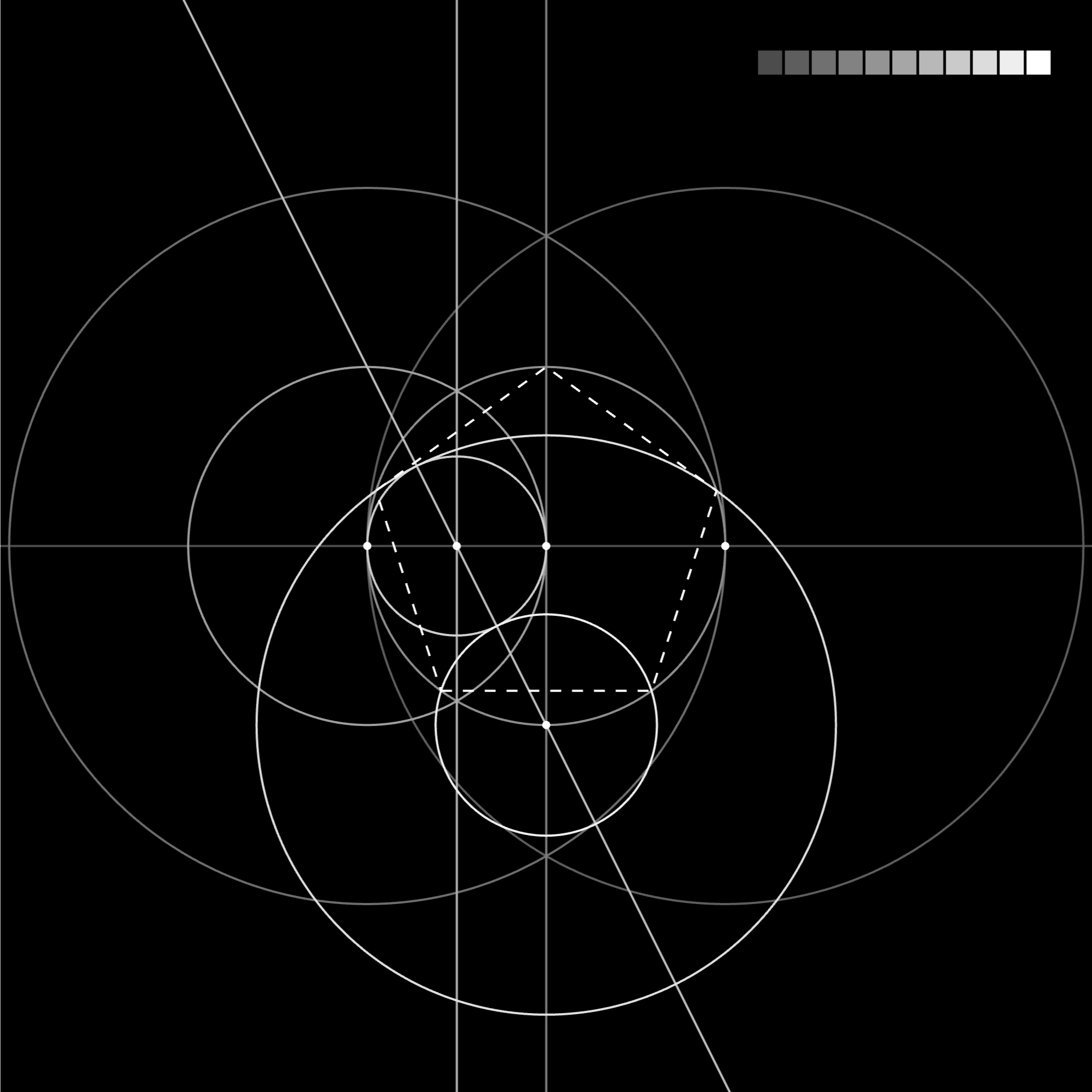
A highlight of Euclid’s Elements is the exact construction of a regular pentagon using a straight edge and a compass. But I’ve noticed recently that some of the pentagon constructions on YouTube are merely approximations – and are not advertised or understood as such. Furthermore, many of these constructions require non-collapsible compasses, which can “carry” lengths from one place to another, thereby shortcutting the classical process.
Here I present a rigorous construction of a pentagon by just drawing lines and circles through intersections of previous lines and circles (from a pre-existing pair of points), which can be replicated by a straight edge and the ancient Greek collapsible compass. Rather than animate the construction, I color code the lines and circles by hues or grays in order of execution. I implement the construction in the Wolfram Language, formerly known as Mathematica, and thereby confirm the exactness of the result.
For variety, the hues version is rotated with respect to the grays version, and the code follows the figures.

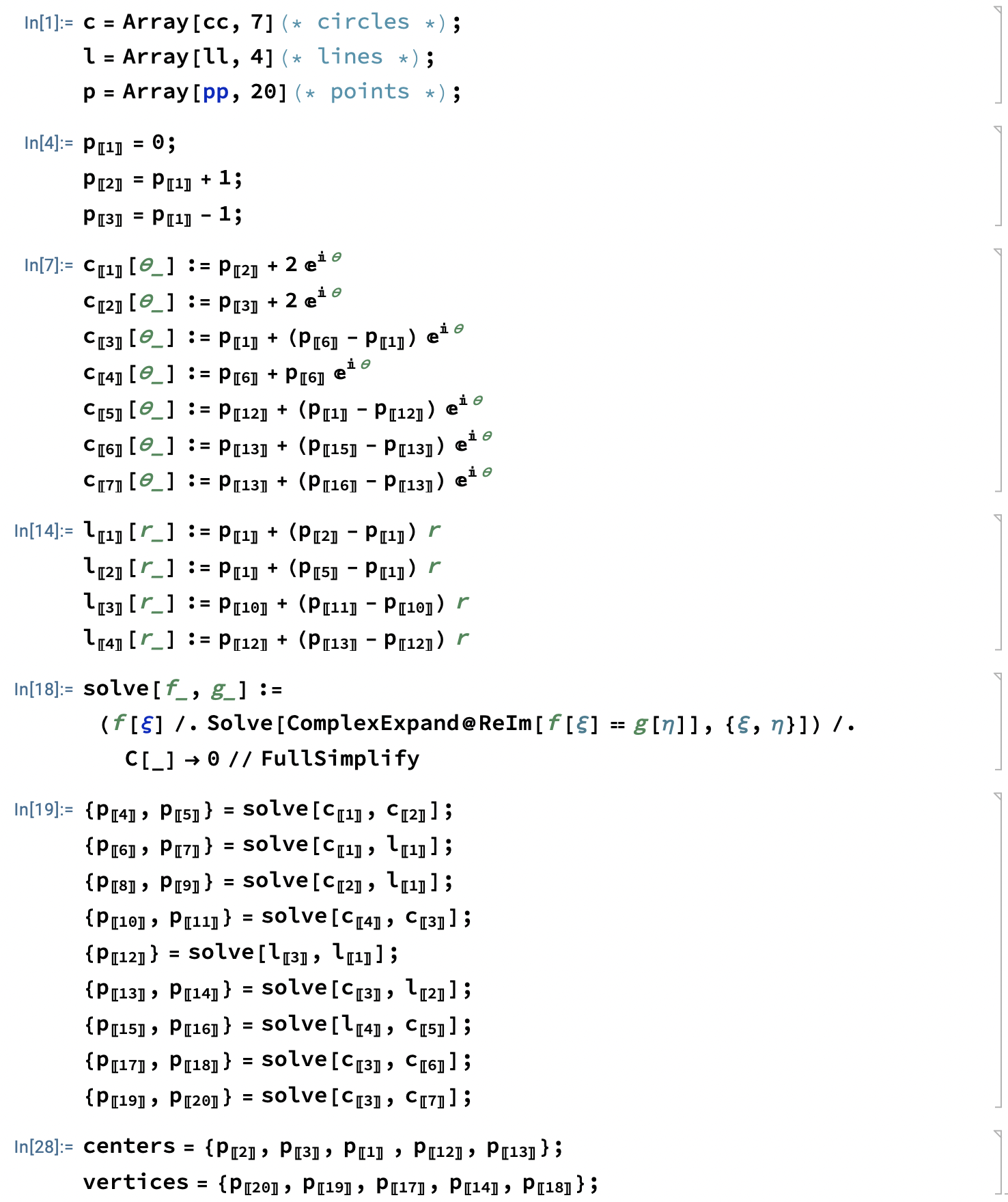
In Mathematica, I define circles, lines, and points as complex numbers and solve for intersections algebraically.
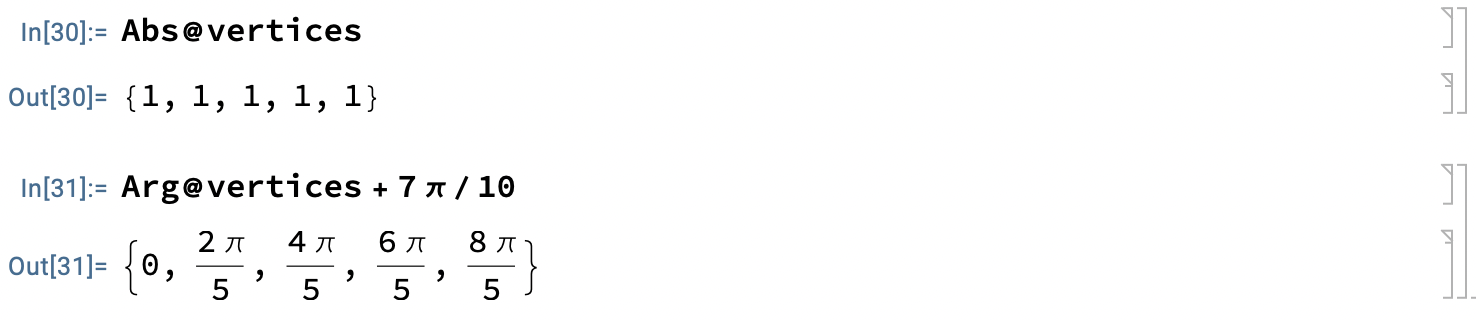
The moduli and arguments of the complex vertices verify the pentagonal geometry.
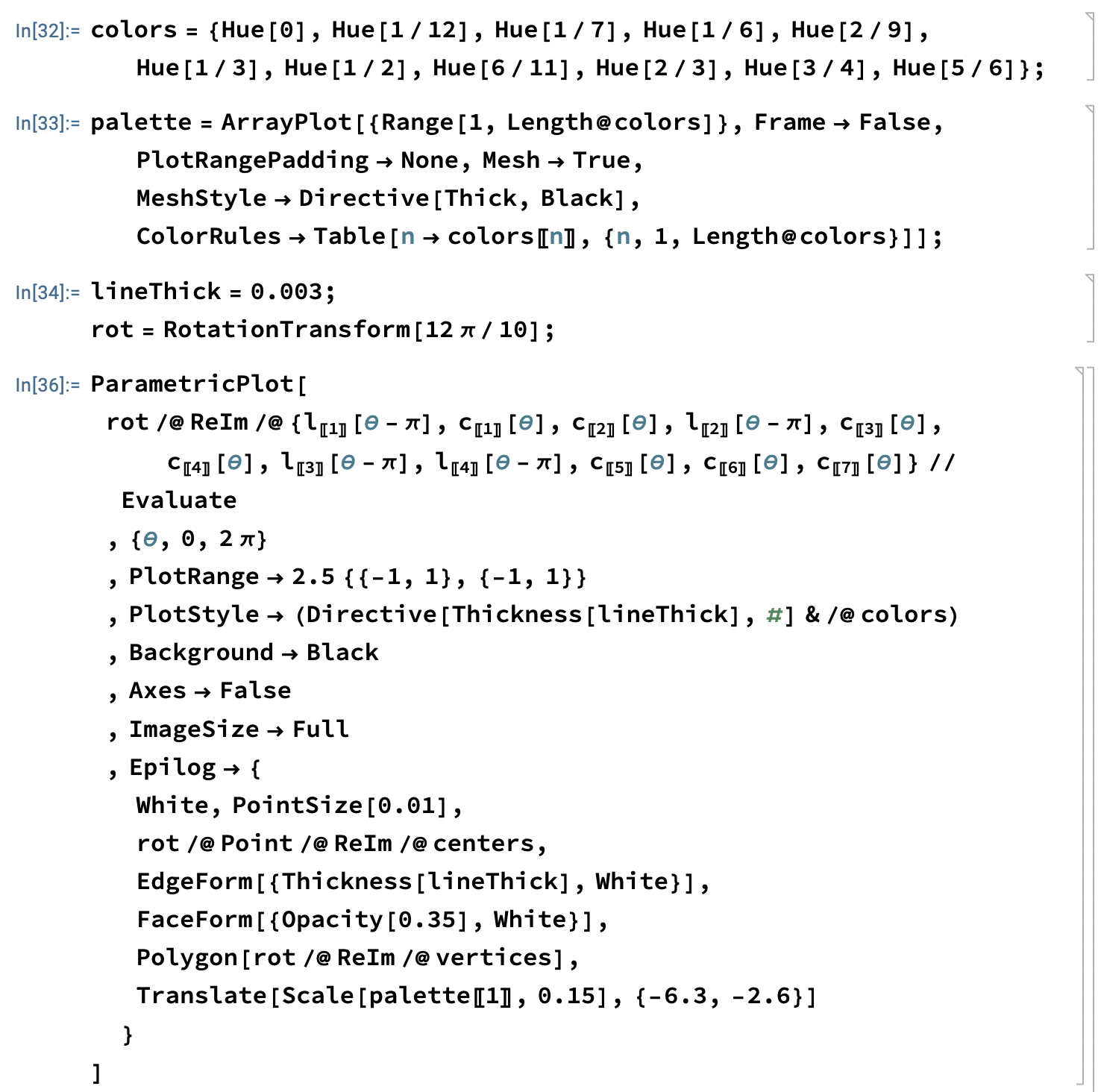
The ParametricPlot function draws the 7 circles and 4 lines, with white dots at circle centers.
Thanks, Mark! I enjoy reading your posts as well.