
50 years ago was summer 1976, post Apollo, but pre-Space Shuttle. On July 20th, the seventh anniversary of the Apollo 11 Moon landing, the Viking 1 spacecraft made the first fully successful landing on Mars. (5 years earlier, the Mars 3 spacecraft ceased communicating just 110 seconds after landing.)
My family owned and operated a small motel in Vermont. But on that day, we were glued to the TV watching the news coverage of the Viking 1 landing. In those days, the martian surface was mysterious, and indeed the Viking program was designed to search for extant life on Mars, and I did not know what to expect.
Data took 19 minutes to reach Earth from Mars. I vividly remember the electrifying reveal of Viking’s first grayscale photograph, slowly assembling itself on the TV screen, left-to-right. First we saw grains, and pebbles, and rocks, and finally one of the lander’s footpads, rivets and all. The picture clarity and exposure seemed amazing. I remember the excited commentary of Thomas Mutch, leader of the lander imaging team, who would tragically die just four years later while mountain climbing.
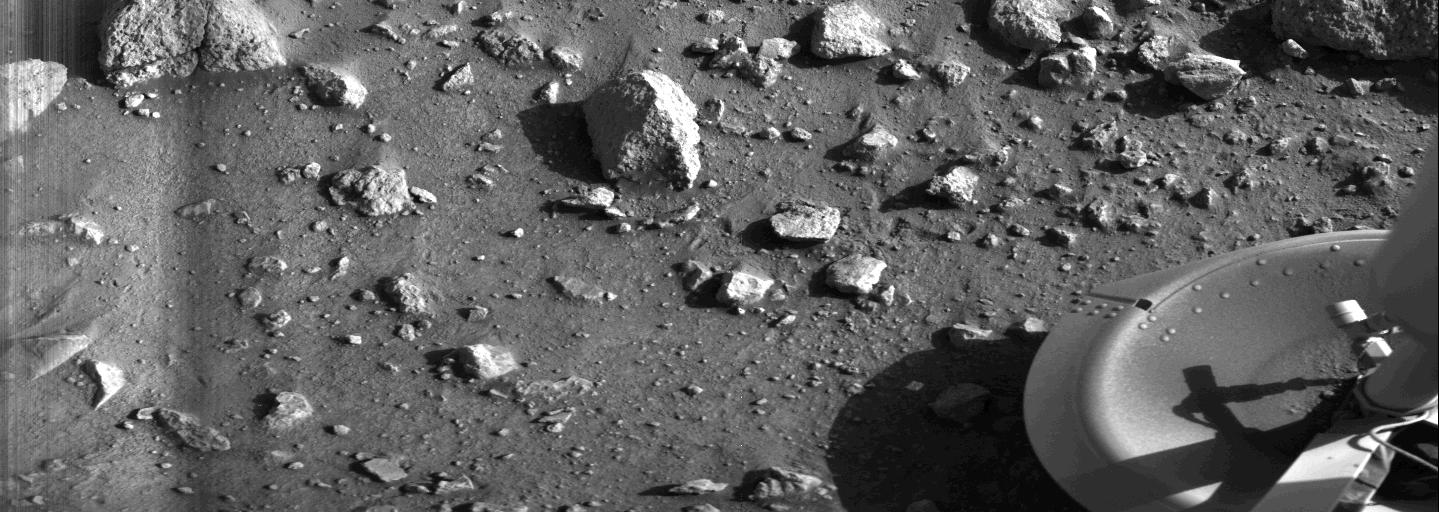
First photograph from the surface of Mars, 1976 July 20, by the Viking 1 lander.
Soon after, on our car’s radio, I heard the first color photo from Viking 1 showed an Earth-like bluish sky. Later I learned that the photo’s color balance overcorrected the martian atmosphere to look terrestrial, as is often done nowadays to aid analysis by terrestrial geologists, and the color balance was re-adjusted to show an alien sky. I hope to live long enough to hear humans on Mars describe their direct subjective experiences of the martian sky, which seems to vary from pale yellow-brown at noon to blue at dusk, probably due to dust in the air.