
The way a ball’s volume varies with dimension is both fascinating and practically important (in statistical physics, data science, and elsewhere). Here I offer an accessible derivation.
Recursion
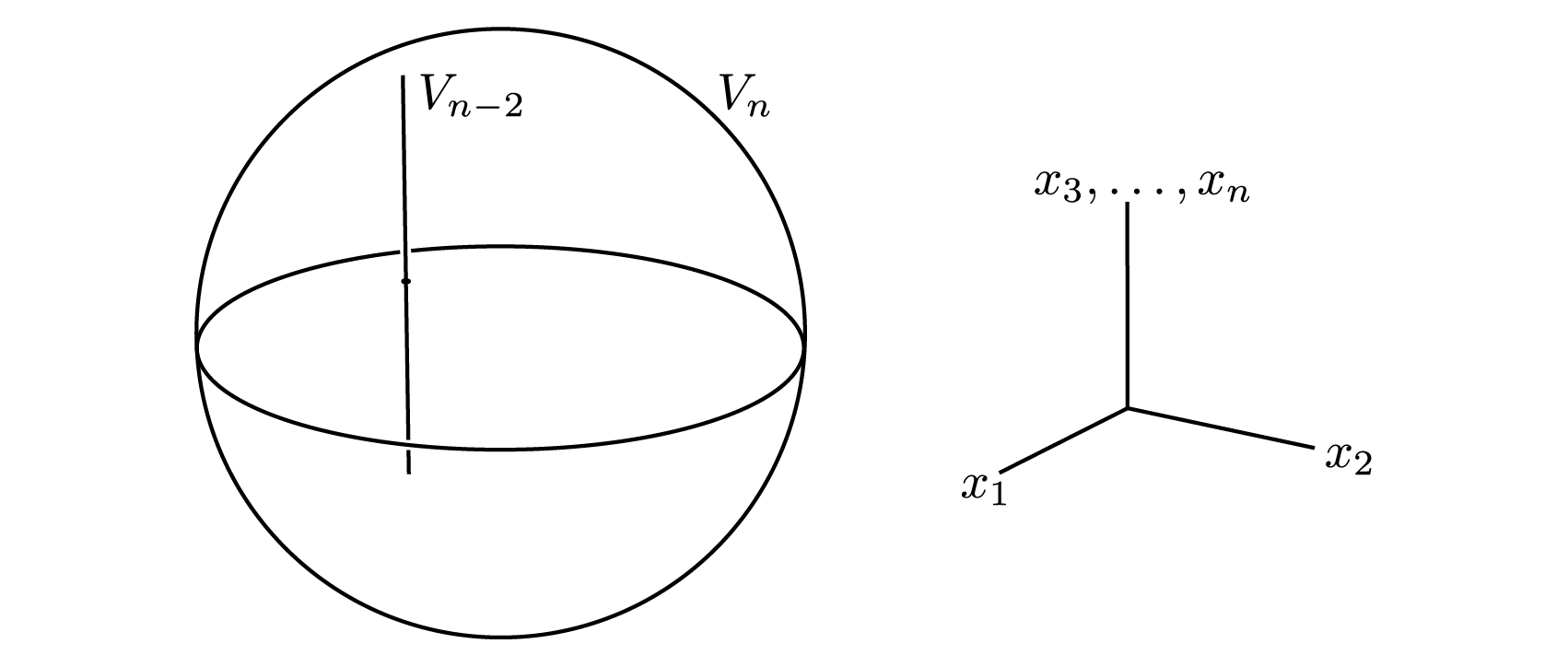
Let V_n(R) be the volume of a ball of radius R in dimension n. Note that V_1(R)=2R, V_2(R)=\pi R^2, V_3(R)=4\pi R^3/3, and V_n(R)=R^nV_n(1). The volume of a unit n-ball
\begin{aligned}V_n(1)&=\mathop{\int \cdots \int}\limits_{x_1^2 + \cdots + x_n^2 \le 1} \mathrm{d}x_1 \cdots \mathrm{d}x_n\\&=\mathop{\int\int}\limits_{x_1^2 + x_2^2 \le 1} \mathrm{d}x_1\mathrm{d}x_2\left(\mathop{\int \cdots \int}\limits_{x_3^2 + \cdots + x_n^2 \le 1-x_1^2-x_2^2} \mathrm{d}x_3 \cdots \mathrm{d}x_n \right)\\&=\mathop{\int\int}\limits_{x_1^2 + x_2^2 \le 1} \mathrm{d}x_1\mathrm{d}x_2 V_{n-2}\left(\sqrt{1-x_1^2-x_2^2}\right)\\&=\mathop{\int\int}\limits_{x_1^2 + x_2^2 \le 1} \mathrm{d}x_1\mathrm{d}x_2 \left(\sqrt{1-x_1^2-x_2^2}\right)^{n-2}V_{n-2}(1)\\&=V_{n-2}(1)\mathop{\int\int}\limits_{\substack{0\le r\le 1\\ 0\le \theta\le 2\pi}} r\mathrm{d}\theta\mathrm{d}r \left(1-r^2\right)^{n/2-1}\\&=V_{n-2}(1)\int_0^{2\pi} \!\mathrm{d}\theta\int_0^{1} \mathrm{d}r\,\left(1-r^2\right)^{n/2-1}r \\&=V_{n-2}(1)\,\theta\bigg|_0^{2\pi}\, \frac{(1-r^2)^{n/2}}{n/2}\left(\frac{1}{-2}\right)\bigg|_0^{1}\\&=V_{n-2}(1)\,\frac{2\pi}{n},\end{aligned}and so
\color{red}R^n\color{black}V_n(1)=\color{red}R^{n-2}\color{black}V_{n-2}(1)\,\frac{2\pi \color{red}R^2\color{black}}{n}implies the volume of a generic n-ball
V_n(R)=V_{n-2}(R)\,\frac{2\pi R^2}{n}.
Solution
This recursion has the beautiful solution
\boxed{V_n(R)=\frac{\pi^{n/2}}{(n/2)!} R^n},where
\begin{aligned}n!&=\int_0^\infty \!\!\!\!\mathrm{d}x\, e^{-x} x^n\\&= -e^{-x}x^n \bigg|_0^\infty + \int_0^\infty \!\!\!\!\mathrm{d}x\, e^{-x} n x^{n-1}\\&=n(n-1)!\end{aligned}is itself recursive with
0!=\int_0^\infty \!\!\!\!\mathrm{d}x\, e^{-x} = -e^{-x} \bigg|_0^\infty = 1,(so, for example, 4! = 4\cdot 3\cdot 2\cdot 1 \cdot 0! = 4 \cdot 3 \cdot 2 \cdot 1 = 24) and
\begin{aligned}\left(-\frac{1}{2}\right)!&=\int_0^\infty \!\!\!\!\mathrm{d}x\, e^{-x} x^{-1/2}\\&=\int_0^\infty \!\!\!\!2z \mathrm{d}z\, e^{-z^2}z^{-1}\\&=\int_{-\infty}^\infty \!\!\!\! \mathrm{d}z\, e^{-z^2}\\&\color{red}=\sqrt{\int \mathrm{d}x\, e^{-x^2}\int \mathrm{d}y\, e^{-y^2}}\\&\color{red}=\sqrt{\iint \mathrm{d}x\mathrm{d}y\, e^{-(x^2+y^2)}}\\&\color{red}=\sqrt{\iint r \mathrm{d}\theta\mathrm{d}r\, e^{-r^2}}\\&\color{red}=\sqrt{\int_0^{2\pi} \!\!\!\!\mathrm{d}\theta\int_0^\infty \!\!\!\!\mathrm{d}r\, re^{-r^2}}\\&\color{red}=\sqrt{\theta\bigg|_0^{2\pi}\frac{e^{-r^2}}{-2}\bigg|_0^\infty}\\&=\sqrt{\pi},\end{aligned}my favorite integral. Check that initially
\begin{aligned}V_1(R)&=\frac{\pi^{1/2}}{(1/2)!}R^1=\frac{\pi^{1/2}}{(1/2)(-1/2)!}R=2R,\\V_2(R)&=\frac{\pi^{2/2}}{(2/2)!}R^2=\pi R^2,\end{aligned}and thereafter
\begin{aligned}V_n(R)&=\frac{\pi^{n/2}}{(n/2)!}R^{n}=\frac{\pi\pi^{n/2-1}}{(n/2)(n/2-1)!}R^2 R^{n-2}\\&=\frac{\pi^{(n-2)/2}}{((n-2)/2))!}R^{n-2}\frac{2\pi R^2}{n}=V_{n-2}(R) \frac{2\pi R^2}{n}.\end{aligned}Analysis
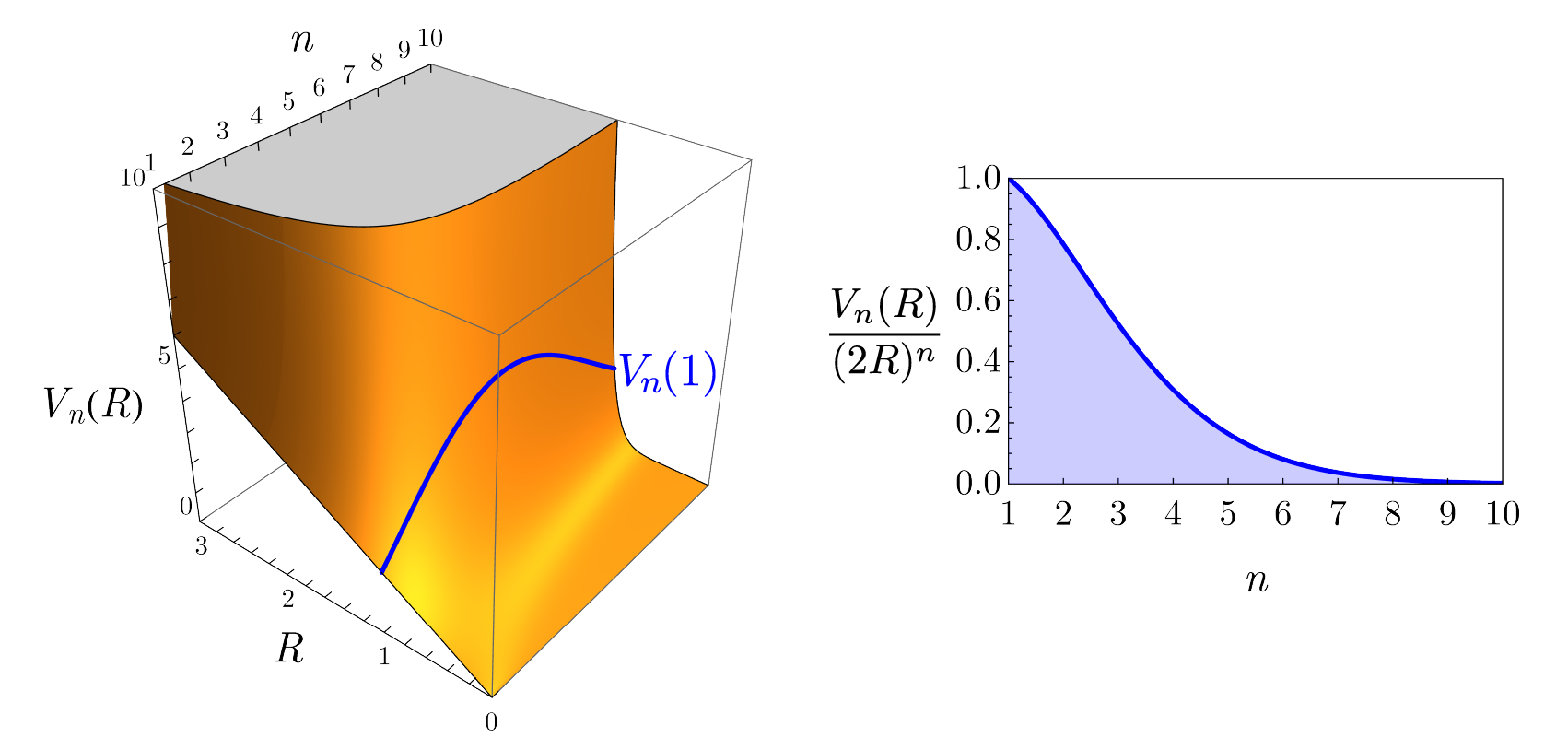
Not only does the volume V_n(1) of a unit n-ball decrease to zero for sufficiently large n, but the ratio V_n(R)/(2R)^n of the volume of a generic n-ball to its circumscribing n-cube decreases monotonically to zero! Understand this by noting that the 2^n n-cube corners are at large distances \sqrt{n}R \gg R for large n.
Thanks, Mark! I enjoy reading your posts as well.