
I recently coauthored an article in the International Journal of Bifurcation and Chaos that reports efficiently performing logic with a simple nonlinear electronic device that exhibits negative resistance, something I had previously theorized.
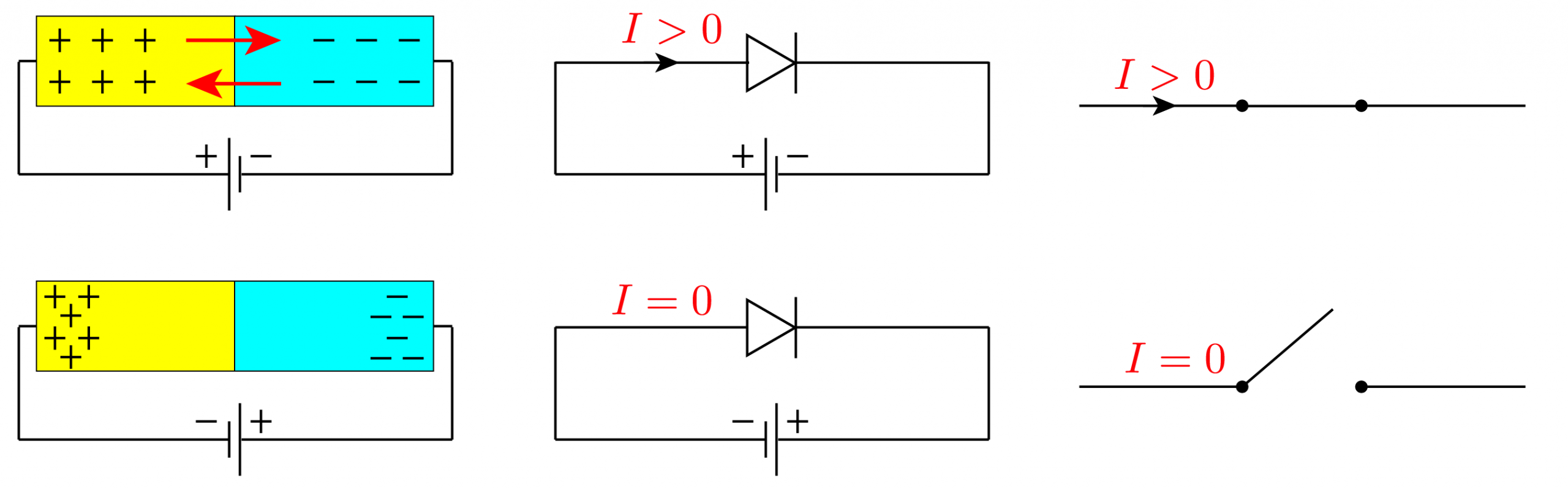
At the heart of the device is a single p-n junction, which is formed by a silicon semiconductor crystal doped with impurity atoms (like boron or antimony) so the n-type side contributes negative charges called electrons to conduction, while the p-type side contributes missing electrons called holes, which act like positive charges. Depending on the polarity of the attached battery, the intermediate depletion layer contracts or expands, and the junction acts like a switch or valve called a diode, either conducting current or blocking it.
The Uni-Junction Transistor (UJT) is a single asymmetric p-n junction, whose equivalent circuit features an ideal diode that outputs to two internal resistors, the bottom of which is variable. The three attachment points are conventionally called the side “emitter” E, the bottom “base” B_1, and the top “base” B_2.
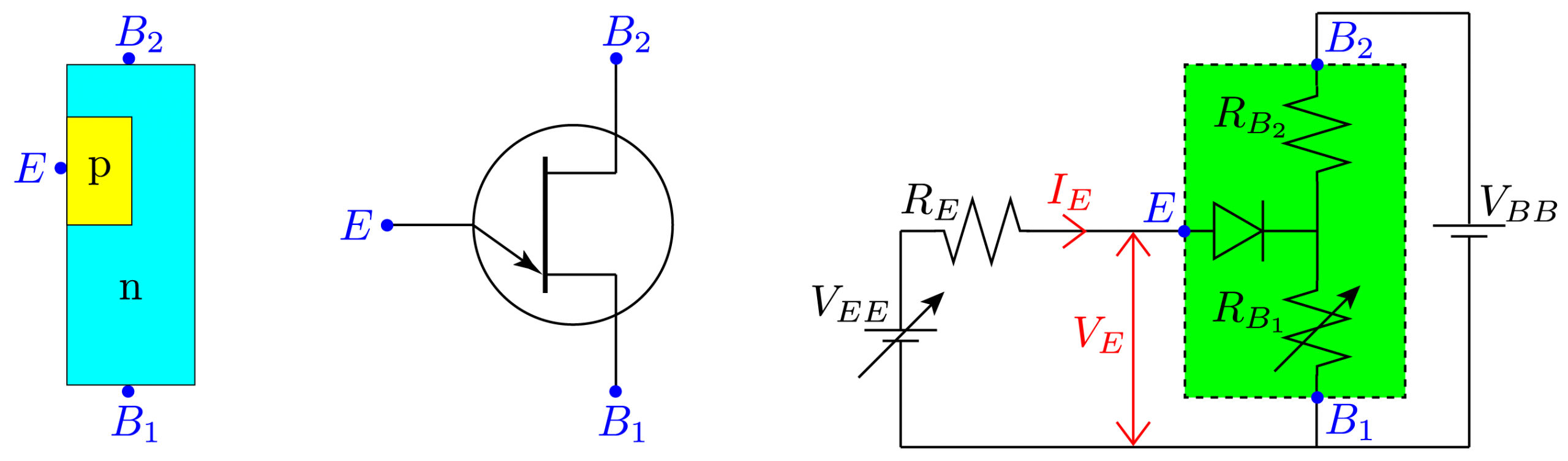
Power the UJT by a static voltage V_{BB} between the bases so B_2 > B_1, and control the emitter voltage V_E and current I_E with the variable voltage V_{EE} via a resistor R_{E}. Varying V_{EE} reveals the BJT characteristic voltage-current VI curve (and IV curve) labeled with static resistance R_S = V/I and differential or dynamic resistance R_D = dV/dI (and the corresponding conductances g = 1/R). The current I_E versus voltage V_E is multivalued.
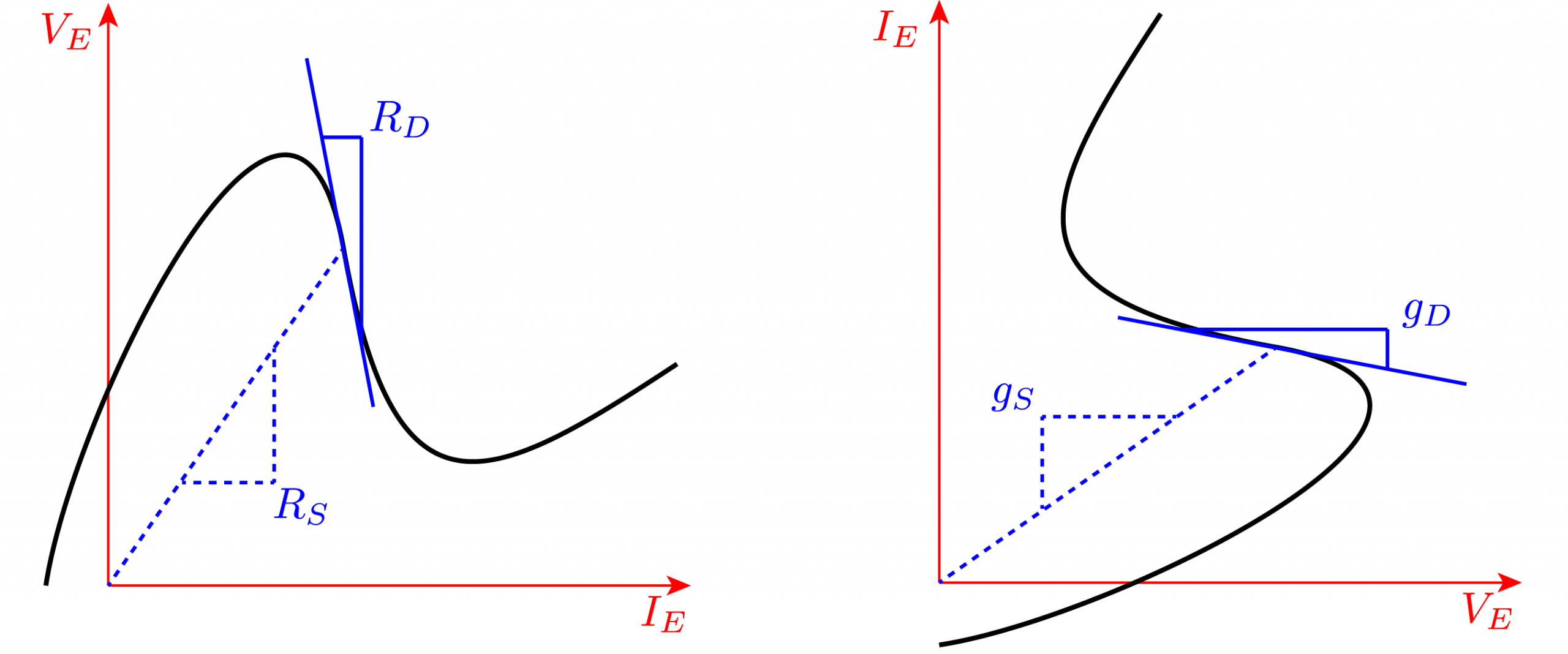
For small V_{EE} the p-n junction is reversed biased, and a small current I_E leaks backward through it. For larger V_{EE}, the p-n junction becomes forward biased, triggering it to inject holes into the n-type bar, where the extra charge carriers dramatically increase conductivity, decreasing the voltage V_{E} while increasing the current I_{E}, in a region of negative differential resistance.
Thanks, Mark! I enjoy reading your posts as well.