
In yet another recent exciting advance in mathematical tiling, last month Ioannis Tsiokos and the reasoning model GPT-6 Astra announced the discovery of a 3D aperiodic mono tile, an ein stein (or “one-stone”), a single shape that forces a non-periodic tiling of space, and reported formal verification by the Lean 4 theorem-prover software. Independently Felix Flicker and Chaim Goodman-Strauss soon simplified and elucidated the result.
The shape is a decorated 3D chair: a cube missing one of its corners, as in the figure below. The undecorated chair can tile space either periodically or nonperiodically, but the decorations are chosen to prohibit periodicity and force a hierarchical tiling of chairs into inflated superchairs with the same matching rules at twice the length scale. Thus, if the pattern repeats through a translation \vec d, it must repeat through 2^n\vec d, but \vec d\neq 2^n \vec d for \vec d \neq 0. (The inflation can push the missing octant to infinity or, alternately, the octant can be recursively filled with deflated chairs.)
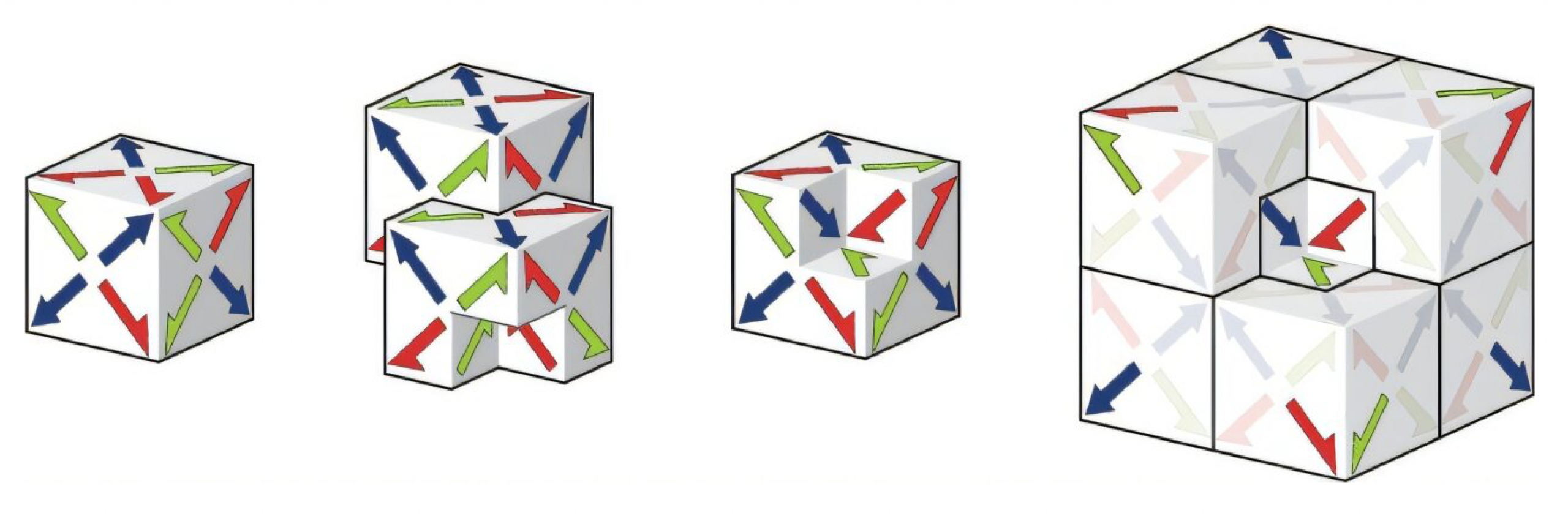
In Goodman-Strauss’s scheme, inflate the chair by arranging copies (left) so green arrows match red arrows and blue arrows match blue arrows to form a similar superchair (right), and repeat infinitely.
Freely downloadable computer files are already available from Bob MacKay to 3D-print copies of the chair, where patterns of bumps and dents enforce the matching rules (and cause the copies to “stick” together).
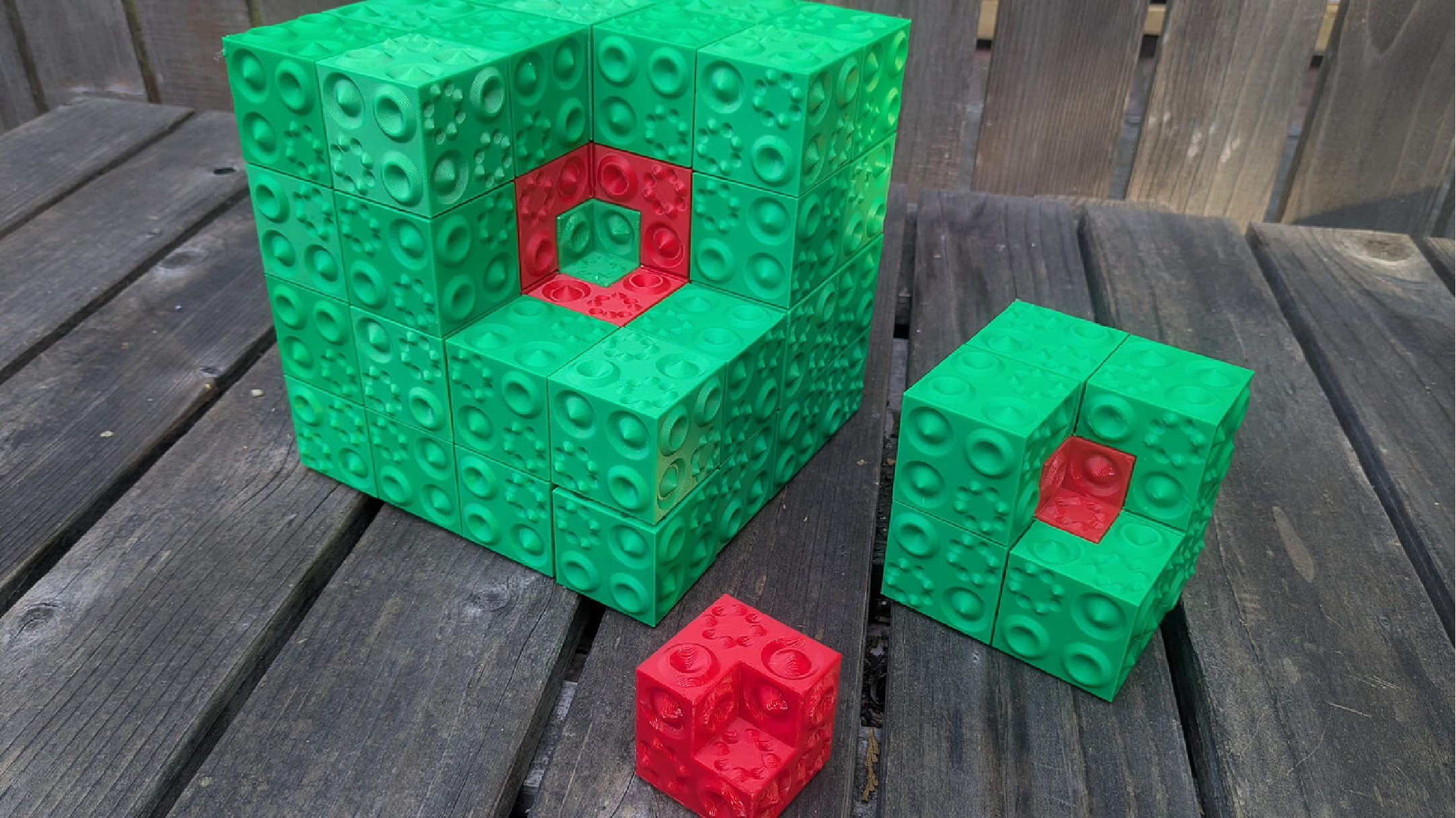
MacKay’s 3D-printed decorated chairs.
Thanks, Mark! I enjoy reading your posts as well.