
Yesterday, OpenAI announced the solution to the Millennium-Prize Navier-Stokes problem: an initially smooth fluid can develop a singularity in finite time. More precisely, in a fluid modeled by the Navier-Stokes equations (Newton’s second law for incompressible fluids), from zero initial speeds a smoothly varying localized force can create a vortex that combines inward spiraling with axial outflow to produce in finite time an infinite speed (despite finite total energy), as in the annotated OpenAI graphic below.
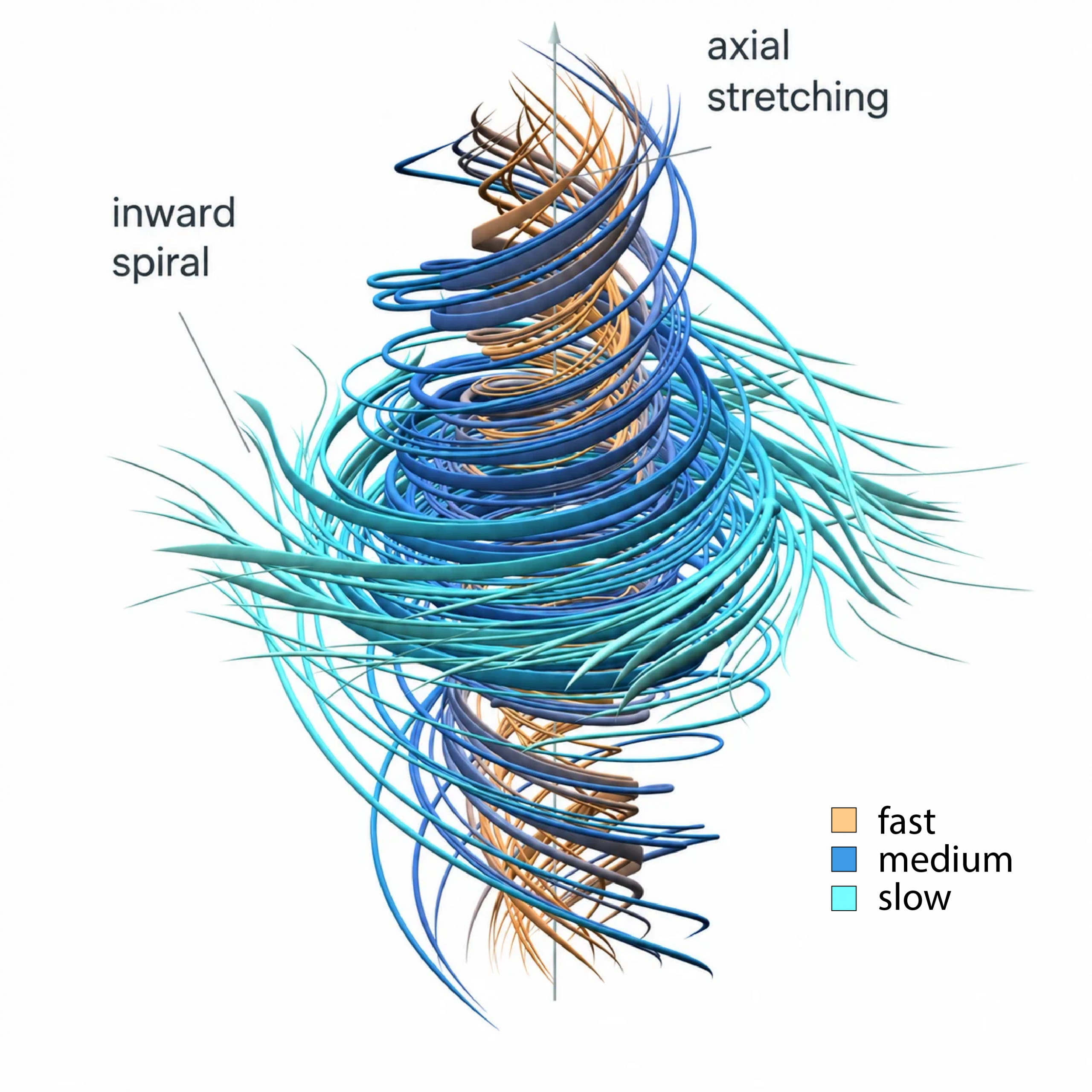
According to OpenAI, an internal artificial intelligence model, significantly more capable than its Generative Pre-trained Transformer GPT‑6 Astra, solved the problem in 88 hours. Formalization and verification using the Lean proof-checking software took an additional 17 hours.
Over the past quarter century, mathematicians had made steady progress on the Navier-Stokes problem, with opinion gradually shifting from Navier-Stokes regularity to singularity. And while its solution may be a watershed moment, with artificial intelligence revolutionizing mathematics the way the telescope revolutionized astronomy, I’m personally unsurprised by the result itself, as non-collisional singularities exist even in the Newtonian -body problem for .
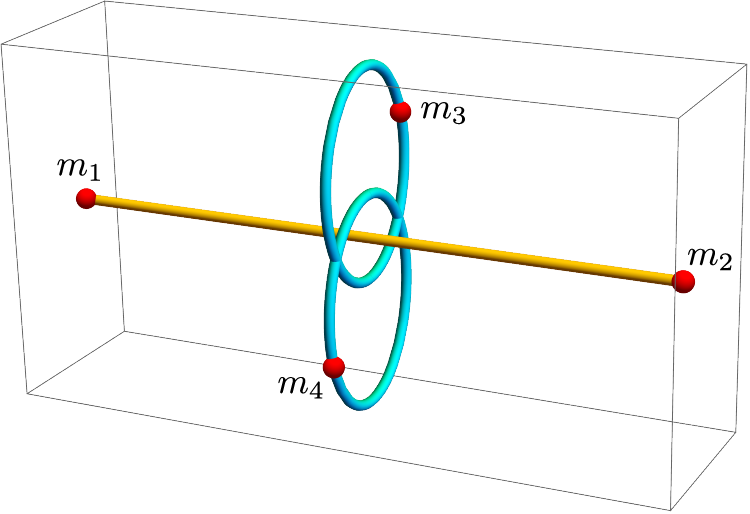
In a recent scheme by Joseph Gerver, Guan Huang, and Jinxin Xue, for a delicate fractal-like Cantor set of initial conditions, idealized point masses interacting gravitationally shuffle back and forth in a near-line and experience near-triple collisions that contract the pair in pseudo-Keplerian orbit, converting potential to kinetic energy (while maintaining constant total energy) and accelerating the masses in finite time to infinity, where yellow and cyan lines suggest the general motion in the graphic below.
Thanks, Mark! I enjoy reading your posts as well.