
Why is minus-one-twelfth associated with the sum of the natural numbers? It’s the constant term in the series expansion of the corresponding smoothed or regularized sum! Introduce a decay factor, and in the limit of vanishing decay, the finite-non-zero part of the resulting sum is minus-one-twelfth, as one can quickly verify in Mathematica using (for example) an exponential decay:
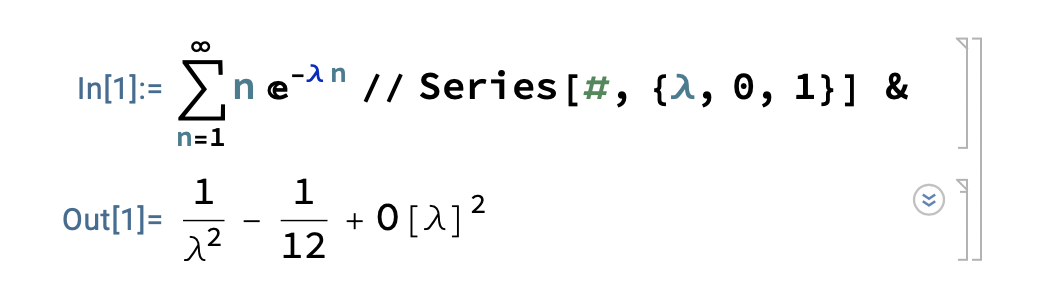
In more detail, let the sum of natural numbers
S = \sum_{n=0}^\infty n = 1+2+3+\cdots = \infty.To elucidate this divergent sum and identify the little bit of finiteness that can be extracted from it, introduce an exponential convergence factor and integrate to find
\mathcal{S}\stackrel{\color{red}\lambda \downarrow 0}{=}\sum_{n=0}^\infty n\,\color{red} e^{-\lambda n}\color{black} = -\frac{d}{d\lambda} \sum_{n=0}^\infty e^{-\lambda n} = -\frac{d}{d\lambda} \sum_{n=0}^\infty \left(e^{-\lambda}\right)^n.Sum the resulting geometric series to get
\begin{aligned}\mathcal{S}&\stackrel{\color{red}\lambda \downarrow 0}{=} -\frac{d}{d\lambda} \left( \frac{1}{1-e^{-\lambda}} \right)= \frac{e^{-\lambda}}{\left(1-e^{-\lambda}\right)^2}\color{red}\frac{e^{2\lambda}} {e^{2\lambda}} \\ & \color{black}= \frac{e^{\lambda}}{\left(e^{\lambda}-1\right)^2}= \frac{e^{\lambda}}{\left(1-e^{\lambda}\right)^2}\color{black},\end{aligned}which is thus an even function of \lambda. Replace the exponentials by their power series expansions
\begin{aligned}\mathcal{S}&\stackrel{\color{red}\lambda \downarrow 0}{=}\frac{1+\lambda+\lambda^2/2!+\lambda^3/3!+\cdots}{\left(1+\lambda+\lambda^2/2!+\lambda^3/3!+\cdots-1 \right)^2}\\ &=\frac{1+\lambda+\lambda^2/2+\cdots}{\lambda^2\left(1+\lambda/2+\lambda^2/6+\cdots \right)^2},\end{aligned}expand the denominator square
\begin{aligned}&\left(1+\lambda/2+\lambda^2/6+\cdots\right)^2=\\ \\&+1\hspace{1.2em}+\lambda/2\hspace{0.7em}+\lambda^2/6\hspace{0.2em}\phantom{+\cdots}\\ \rule{0pt}{1.3em}&+\lambda/2\hspace{0.43em}+\lambda^2/4\hspace{0.37em}\color{red}+\lambda^3/12\color{black}\phantom{+\cdots}\\ \rule{0pt}{1.3em}&+\lambda^2/6\color{red}+\lambda^3/12+\lambda^4/36+\cdots&\color{black} \\ \\&=1+\lambda+7\lambda^2/12+\cdots\end{aligned}and use long division
\begin{array}{r}1-\lambda^2/12+\cdots\\ 1+\lambda+7\lambda^2/12+\cdots \,{\overline{\smash{\big)}\,1+\lambda+\phantom{9}\lambda^2/2\phantom{9} +\cdots}}\\ \underline{1+\lambda+7\lambda^2/12+\cdots }\\0-\lambda^2/12+\cdots\\ \underline{-\lambda^2/12+\cdots}\\0+\cdots \end{array}to show
\mathcal{S} \stackrel{\color{red}\lambda \downarrow 0}{=} \frac{1}{\lambda^2} \left(1-\frac{\lambda^2}{12}+\mathcal{O}[\lambda^4]\right),or
\sum_{n=0}^\infty n\color{red}\, e^{-\lambda n}\color{black}\stackrel{\color{red}\lambda \downarrow 0}{=}\color{red}\underbrace{\ +\frac{1}{\lambda^2}\ \ }_\text{Diverge}\color{black}\underbrace{\ -\frac{1\vphantom{\lambda^2}}{12}\ \ }_\text{Remain}\color{red} \underbrace{\vphantom{-\frac{1\vphantom{\lambda^2}}{12}}+\mathcal{O}[\lambda^2]}_\text{Vanish}\color{black},or
1+2+3+\cdots \stackrel{R}{=} -\frac{1}{12},where R denotes regularized, renormalized, and remainder. R also denotes Ramanujan, who discovered this association without any formal mathematical training.
Thanks, Mark! I enjoy reading your posts as well.