
With Mahala Wanner and Gus Thomas, Niklas Manz and I recently published an article Chemical wires: reaction-diffusion waves as analogues of electron drift in the journal Transport Phenomena. Mahala began the work during our summer 2022 REU, and Gus continued it for his 2025 Senior IS.
We used chemical reaction-diffusion waves in narrow channels to model electron drift in wires. By varying the initial conditions of an excitable Belousov–Zhabotinsky (BZ) medium, we achieved careful, quantitative control of BZ wave speeds in the range of electron drift speeds in conductors, a few millimeters per minute. We compared the speeds of the easily observable BZ waves and their computer simulations with theoretical electron drift speeds to explore the effects of wire radius, electric current, and material composition. Such BZ waves are compelling visual analogues of electron drift.
The slow effective speed of typical electrical currents, despite the large quantum and thermal speeds of electrons in common wires, contributes to misconceptions about the nature of information transfer via current; individual electron trajectories do not transmit electrical signals at high speeds, but perturbations in the accompanying electromagnetic fields do. To build better intuition, below is an animation of a 10 mm / min electron drift, represented by the filling bar, with a penny for scale.
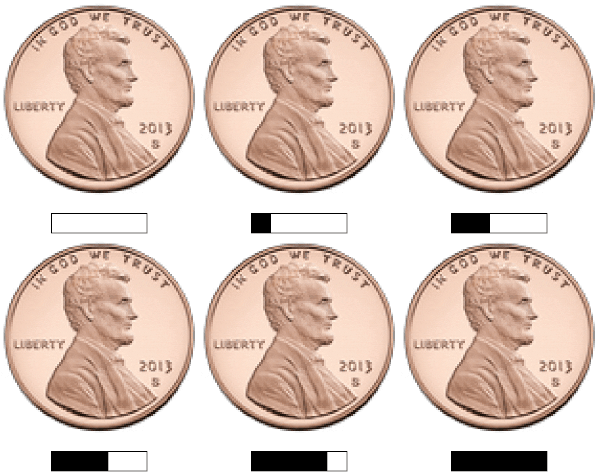
Electron drift simulation to scale.
(You may need to click or tap to see the animation.)
Thanks, Mark! I enjoy reading your posts as well.